
Plane
The free alternative toJira,Linear,Monday



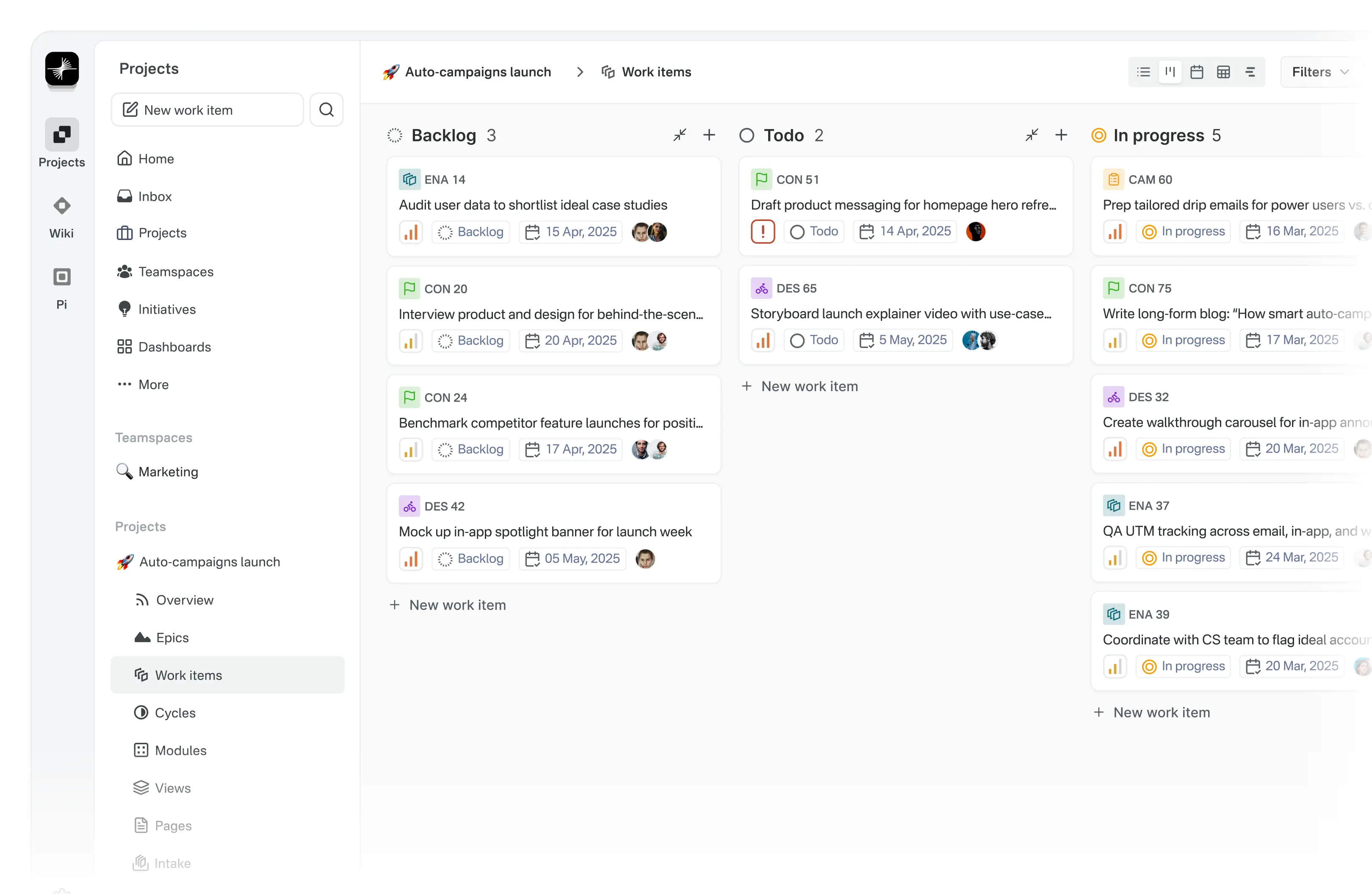
Plane is a full project management tool you install on your own server. You get what you know from Jira, Linear or ClickUp: work items with their properties, cycles for your sprints, modules to break down a big piece of work, five ways to display the same list, saved views, documentation pages sitting next to the work, and an inbox to triage incoming requests. The makeplane/plane repo is past 59,000 stars on GitHub and gets commits every day. The Community edition is AGPL v3, with no locked module hidden in the code: the vendor keeps its paid features in a separate closed repo, the Commercial edition. What you get for free when self-hosting matches the free tier of their cloud: projects, work items, cycles, modules, views, project pages, estimates and request intake. The company wiki, time tracking, dashboards, project templates and intake by email or web form all need a paid licence.
Versus Linear: the match
Price
Plane
€0, you only pay for your server
Linear
€9 per user per month
Your data
Plane
At home, in a Postgres database you back up
Linear
On their servers
Number of people
Plane
Unlimited, no cost per head
Linear
Every extra person is billed
| VS | Plane | Linear ↗ |
|---|---|---|
| Price | €0, you only pay for your server | €9 per user per month |
| Your data | At home, in a Postgres database you back up | On their servers |
| Number of people | Unlimited, no cost per head | Every extra person is billed |
| Sprints, modules and pages | Included in the free version | Included, with 5 teams maximum |
| Request intake | Included, email and forms are paid | Included, assisted triage is on Business |
| Code | AGPL v3, to read and fork | Closed |
How to install it (even from zero)
This is not an app you download. Plane runs on a server: plan for a machine with 2 cores and 4 GB of memory minimum, 8 GB as soon as several of you use it, plus a domain name pointing at it.
- 1
Paste this prompt into Claude Code
It starts from your empty server, installs the Community edition from the official repo, sets the domain and HTTPS, then creates your admin account:
Installe Plane sur mon serveur en partant de zéro (l'outil de gestion de projet open source, dépôt GitHub makeplane/plane). Connecte-toi à mon VPS en SSH, vérifie que Docker et Docker Compose sont présents, installe-les sinon. Crée un dossier plane-selfhost, télécharge le script setup.sh de la dernière version publiée du dépôt officiel, rends-le exécutable et lance l'installation de l'édition Communauté, celle qui est sous licence AGPL. Ouvre ensuite le fichier plane.env : mets mon nom de domaine en https dans WEB_URL et CORS_ALLOWED_ORIGINS, choisis un port libre pour LISTEN_HTTP_PORT, et remplace toutes les valeurs secrètes livrées par défaut par des valeurs tirées au hasard, en particulier SECRET_KEY, le mot de passe Postgres et les clés du stockage de fichiers. Installe Caddy devant pour obtenir automatiquement le certificat HTTPS sur mon domaine, démarre les services, puis guide-moi pour créer le compte administrateur de l'instance sur la page god-mode et régler mon serveur SMTP. Pour finir, on crée ensemble un premier projet avec une tâche et un cycle, pour vérifier que tout fonctionne. Explique chaque étape simplement, je débute.

Review the GitHub repository and check whether it is safe to install given my machine and my infrastructure. Ask me as many questions as possible, using widgets, to clarify my request and be as precise as you can.
- 2
Plan for the right machine
Plane is not one container, it is about ten: the web app, the API, background jobs, real-time collaboration, plus Postgres, Redis, RabbitMQ and file storage. The official minimum is 2 cores and 4 GB of memory, 8 GB recommended in production.
- 3
Change the secrets, then keep the instance updated
An August 2026 security advisory was precisely about secret keys shipped hardcoded in the Community edition deployment files. Generate your own, apply updates as soon as a release lands, and run the backup built into the setup.sh script regularly: it exports the database, Redis and uploaded files.
 Paste this prompt into Claude Code
What you actually do with it
Your client projects, sorted into cycles
One project per client, your work items inside, and a two-week cycle for what you are doing now. The burn-down chart at the end of the cycle tells you whether you are keeping pace, with no spreadsheet to fill in on the side.
Incoming requests stop getting lost
Intake puts requests in a separate queue. You look, you accept, you decline, you turn one into a work item. Email sorting and public forms, though, sit in the paid plans.
The docs in the same place as the work
Pages live inside the project, with a real text editor. The spec, the meeting notes and the decisions stay next to the work items, instead of sleeping in a third tool nobody opens.
Project health, at a glance
Before installing an open-source tool, one question matters: is the project alive? These scores are computed from public GitHub data. They are not made up.
82/100
ExcellentVery active, well-maintained project: go ahead with confidence.
- Activity
- 100
- Maintenance
- 100
- Community
- 97
- Maturity
- 90
- Momentum
- 22
Is the code moving? (commits in the last 30 days)
How fresh is the latest update? Fresher is better.
Stars and contributors: people around means help and fixes.
Project age. Old enough to be solid, still alive.
Current pace versus its usual pace: speeding up or dozing off?
The repo in numbers
- GitHub stars
- 59.5k
- Forks
- 5.8k
- Contributors
- 164
- Commits
- 7.2k
- Project age
- 3.8 yrs
- Last commit
- today
- Size
- 211.1 MB
- License
- AGPL-3.0
Built with
- TypeScript 69.9%
- Python 26.9%
- HTML 2.4%
- Shell 0.5%
Scores computed automatically from the GitHub API (last-30-days activity, update freshness, community size, project age). Refreshed daily.

Loucash’s take
8/10
The substance is solid. Plane really does what Linear or Jira do: work items, cycles, modules, views, pages, triage. The repo moves every day, a release ships every two or three weeks, and the Community edition is AGPL v3 with no trap in the code. For a team of two to ten people tired of paying per head, it holds up. What gets in the way is hosting and security. About ten services to run, 4 GB of memory minimum, and automatic HTTPS through Let's Encrypt belongs to the Commercial edition: on Community, putting a reverse proxy in front is your job. Above all, the project publishes a lot of security advisories, twenty-two so far, six of them critical on 3 August 2026 for versions 1.3.1 and earlier, fixed in 1.4.0. Workspace takeover through an invitation, a six-digit code with no attempt limit, secret keys hardcoded in the deployment files. None of that is a deal-breaker, but installing Plane means committing to keeping it updated. One last thing before you jump in: the method Plane pushes in its docs is the Commercial edition, closed, with twelve free seats. It is more comfortable, but it is no longer open source, and moving later from Community to Commercial demands a fresh machine and a backup restore. Pick your side at the start. And do not mistake Plane for a kanban board: if all you want is columns and cards, it is too big for you.
It’s for you if: You run projects with other people, you pay per head at Jira, Linear or Monday, and you already have a server, or you are ready to rent one and keep it updated.
Also worth a look in the library
Formbricks
Business & clients€35/moYour forms and surveys, hosted at home, with no response cap. Typeform shuts the tap at 100 responses a month; here there is no tap.
View details →
HeyForm
Business & clients€35/moThe open source Typeform-style form builder, one question at a time, hosted on your own server. Surveys, quizzes, contact forms, payments: your answers stay in your database, with no cap.
View details →
Twenty
Business & clients€25/moNewThe open source CRM you shape to your business: custom objects, kanban pipelines, workflows, synced email and calendar, AI agents. Replaces Salesforce and the CRM side of HubSpot, without paying per user.
View details →



One email a week that saves you money
Every Tuesday: the open source alternatives that just entered the library, what they replace and what they save you. One email, nothing more.
Free. One email on Tuesdays. Unsubscribe in one click.


Join the Tuesday readers