
Twenty
NewThe free alternative toSalesforce,HubSpot


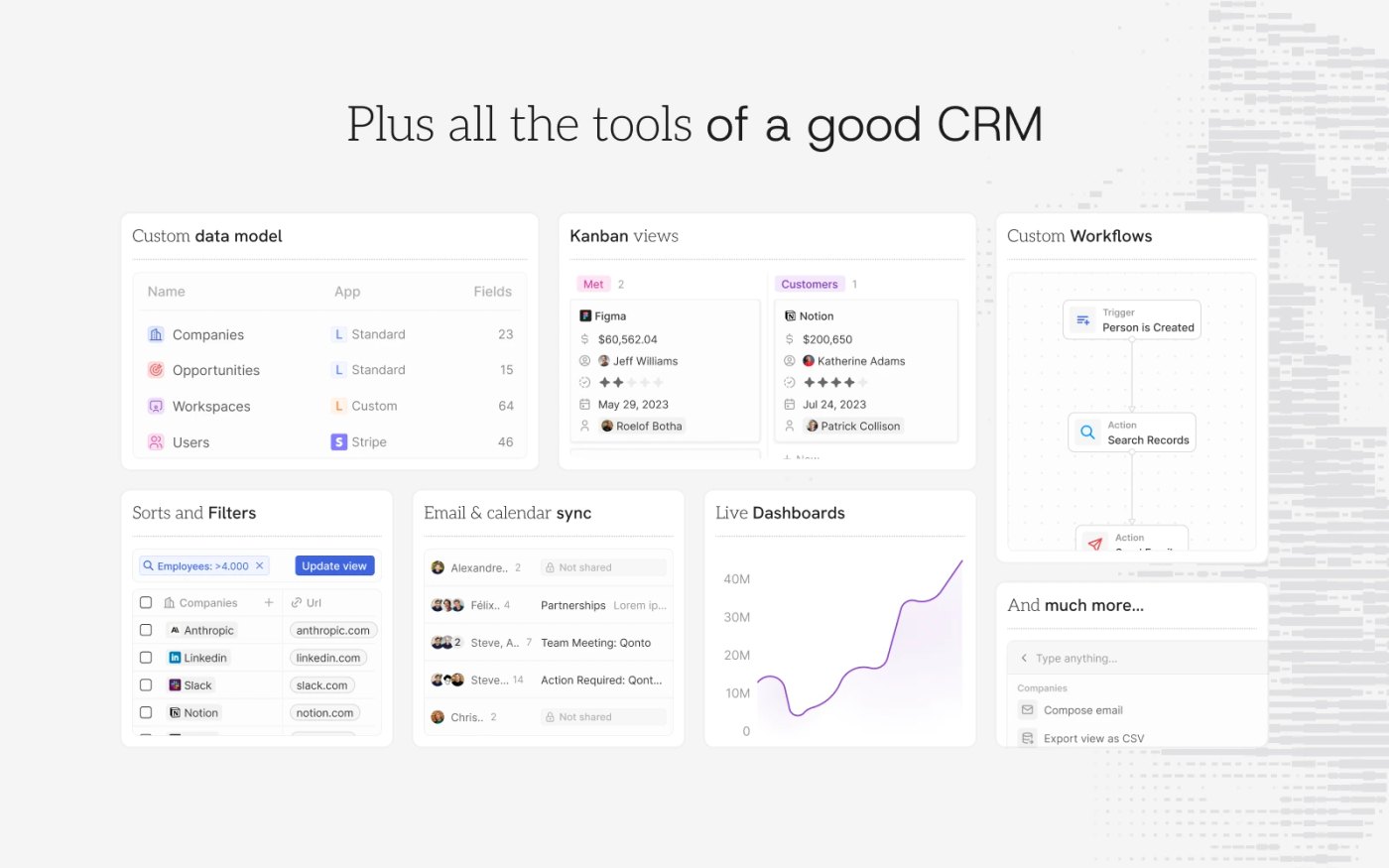
Twenty is the most followed open source CRM on GitHub: over 56,000 stars, over 450 contributors, a French team, and a new release every week. The idea: a CRM you build like the rest of your tools. You start from People, Companies and Opportunities, then create your own objects (case, mission, job site, application), your fields and your relations, in a few clicks or as versioned code. Every object gets its table or kanban views, filters and dashboards. Gmail and Outlook emails and calendars sync onto the records, workflows automate follow-ups, AI agents work on your data with your own API key, and a GraphQL and REST API connects everything to your website, Stripe or your automations. Twenty calls itself "the open alternative to Salesforce, designed for AI". The code is AGPL licensed and installs on your own machine with Docker Compose, for free and with unlimited users. The vendor's cloud costs 9 dollars per user per month if you would rather host nothing, and two enterprise features (SSO, row level permissions) require a paid licence.
Versus Salesforce: the match
Price
Twenty
€0, just your server
Salesforce
€25/user/month on Starter Suite, €100 on Pro Suite
Users
Twenty
Unlimited, no seats to pay
Salesforce
Every seat is billed
Custom objects
Twenty
As many as you want, by click or as code
Salesforce
Depends on the edition, limited in number
| VS | Twenty | Salesforce ↗ |
|---|---|---|
| Price | €0, just your server | €25/user/month on Starter Suite, €100 on Pro Suite |
| Users | Unlimited, no seats to pay | Every seat is billed |
| Custom objects | As many as you want, by click or as code | Depends on the edition, limited in number |
| Where your data lives | On your server, in PostgreSQL | At Salesforce |
| Email and calendar | Gmail, Google Calendar, Outlook synced | Yes, depending on the edition |
| Automations and API | Workflows, webhooks, GraphQL and REST API | Flow and API, depending on the edition |
| AI | AI agents on your data, with your API key | Agentforce, as an add-on |
How to install it (even from zero)
You need a server (a €5 VPS with 2 GB of RAM is enough) and Docker. The prompt does everything, from the official install script to HTTPS, and leaves you a CRM ready to shape.
- 1
Paste this prompt into Claude (Code or Desktop)
It asks where to host, installs Twenty with Docker using the official script, puts HTTPS in front, then has you create your first custom object:
Je veux installer Twenty (CRM open source, dépôt GitHub twentyhq/twenty, site twenty.com) à la place de Salesforce, sur mon propre serveur. Demande-moi d'abord où je veux l'héberger (un VPS Linux que j'ai déjà, ou ma machine pour tester) et le nom de domaine que je veux lui donner. Puis guide-moi pas à pas en suivant la doc officielle docs.twenty.com/developers/self-host/capabilities/docker-compose : installe Docker si besoin, lance le script d'installation en une ligne qui prépare le fichier .env et le docker-compose.yml (génère la clé de chiffrement et le mot de passe PostgreSQL, renseigne l'URL publique du serveur avec mon domaine), démarre les conteneurs, et mets un reverse proxy avec HTTPS devant le port 3000. Ensuite fais-moi créer mon espace de travail, puis un objet sur mesure adapté à mon activité (demande-moi ce que je vends et à qui) avec un champ Étape et une vue kanban. Termine par la connexion de ma boîte mail et de mon agenda, et explique-moi comment mettre à jour Twenty sans perdre mes données : sauvegarde du volume PostgreSQL d'abord, puis changement de version.

Review the GitHub repository and check whether it is safe to install given my machine and my infrastructure. Ask me as many questions as possible, using widgets, to clarify my request and be as precise as you can.
- 2
Create your first object, not just contacts
Settings, then Data model, then new object: Case, Mission, Job site, whatever you actually track. Add a Stage select field and you have your kanban.
- 3
Connect your mailbox and calendar
Settings, then Accounts: Gmail or Microsoft. Conversations land on the records by themselves, nothing left to copy and paste.
 Paste this prompt into Claude (Code or Desktop)
What you actually do with it
Your sales pipeline, as a kanban
Lead, call, quote, signed: you drag cards from one column to the next, and every record keeps the emails, notes and tasks.
A CRM shaped like you, not the other way round
You sell training? Create a Case object with its stages and checklist. Job sites? A Job site object. That is what I do for my students and my clients.
Wired to the rest of your tools
GraphQL and REST API, webhooks, workflows: a call that ends, a Stripe payment, an Instagram DM, and the record updates itself.
Project health, at a glance
Before installing an open-source tool, one question matters: is the project alive? These scores are computed from public GitHub data. They are not made up.
97/100
ExcellentVery active, well-maintained project: go ahead with confidence.
- Activity
- 100
- Maintenance
- 100
- Community
- 96
- Maturity
- 90
- Momentum
- 100
Is the code moving? (commits in the last 30 days)
How fresh is the latest update? Fresher is better.
Stars and contributors: people around means help and fixes.
Project age. Old enough to be solid, still alive.
Current pace versus its usual pace: speeding up or dozing off?
The repo in numbers
- GitHub stars
- 56.9k
- Forks
- 9.1k
- Contributors
- 463
- Commits
- 15.6k
- Project age
- 3.8 yrs
- Last commit
- today
- Size
- 1884.1 MB
- License
- Other
Built with
- TypeScript 81.3%
- MDX 15.8%
- JavaScript 2.3%
Scores computed automatically from the GitHub API (last-30-days activity, update freshness, community size, project age). Refreshed daily.

Loucash’s take
9/10
It is the CRM I use every day, and the one I install for my clients when they want a CRM that fits the way they sell rather than the other way round. With Salesforce or HubSpot, you pay per user and bend to their objects. With Twenty, you create your own: a Training case object with its stages, a Mission object with its deposit and next action, a kanban view for each, all without code. My calls file themselves into the right record through the API. What I like: how fast the project moves (a release a week), the interface that looks like Notion rather than software from 2005, the email and calendar sync, the AI agents wired to your data, and the licence that lets you install everything at home for zero euros. What may bite: you need a server (2 GB of RAM minimum) and someone to update it, even if the prompt handles it. It is not a marketing hub: no email campaigns or landing pages like HubSpot Marketing, for that there is Plunk in the library. And the API has its quirks when you automate finely (rich text notes, links between tasks and custom objects): count on an evening to tame it.
It’s for you if: You sell, train or follow up clients, you pay Salesforce or HubSpot per seat, and you want a CRM that fits your business, hosted at home. If you mostly want an email marketing tool, look at Plunk.
Also worth a look in the library
Formbricks
Business & clients€35/moYour forms and surveys, hosted at home, with no response cap. Typeform shuts the tap at 100 responses a month; here there is no tap.
View details →
HeyForm
Business & clients€35/moThe open source Typeform-style form builder, one question at a time, hosted on your own server. Surveys, quizzes, contact forms, payments: your answers stay in your database, with no cap.
View details →
Budibase
Business & clients€22/moThe business-app builder you host yourself: plug in a spreadsheet, a database or an API, draw screens and forms, add automations. Free on your server, with no user limit.
View details →



One email a week that saves you money
Every Tuesday: the open source alternatives that just entered the library, what they replace and what they save you. One email, nothing more.
Free. One email on Tuesdays. Unsubscribe in one click.


Join the Tuesday readers